
DRDO's failures over the decades have contributed significantly to India becoming the world's biggest weapons importer, points out Lieutenant General Prakash Katoch (retd).

'Pralay' is a 350-500 km short-range, surface-to-surface missile with a payload capacity of 500-1,000 kg. The solid-fuel, battlefield missile is based on the Prithvi Defence Vehicle.

Indian astronaut Shubhanshu Shukla stands on the cusp of history as he prepares to set off on a space odyssey, marking India's return to space flight 41 years after his idol Rakesh Sharma orbited the earth for eight days as part of Soviet Union's Interkosmos programme.
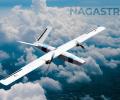
The foremost lesson for India today is to beef up its air defence to cater for multiple drone attacks. As seen in Operation Sindoor, we have come a long way, but there's room for getting better. We must develop a robust and almost impregnable air cover over ourselves, asserts IAF veteran Air Commodore Nitin Sathe (retd).

The missile positioned at launch pad-3 of the ITR swung in to action after getting signal from the radars to intercept a moving aerial target supported by an unmanned air vehicle (UAV) 'Banshee' over the Bay of Bengal, officials said.

The VSHORADS missile is meant for neutralising low altitude aerial threats at short ranges.
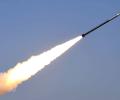
Engineering and construction major Larsen & Toubro (L&T) on Friday said its defence arm has received orders for the Indian ministry of defence for the supply of four regiments of Pinaka weapon systems.
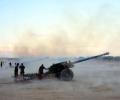
The Indian Army is enhancing the combat prowess of its artillery units along the frontier with China by procuring an array of weapons systems, including an additional batch of 100 K9 Vajra howitzers, swarm drones, loitering munitions and surveillance systems.

SAAW, an indigenously designed and developed 120 kg class smart weapon, has been developed by the Defence Research and Development Organisation.

'In today's launch, the 'Pralay' missile was tested for heavier payload and different range to prove the precision and lethality of the weapon'

Defence Research and Development Organisation is developing an ultra lightweight Unmanned Aerial Vehicle which can be used by troops for reconnaissance of their area of operation.
India is developing a 5,000 km-range Agni ballistic missile, Defence Minister A K Antony said on Monday.

The tests were conducted by the Indian Air Force, which will be the first service to induct the Akash missiles in its inventory.
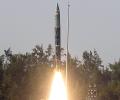
Ahead of Republic Day, the Indian Army announced on Thursday the addition of two new features to this year's parade: battlefield surveillance systems and a Defebce Research and Development Organisation tableau showcasing Pralay, short-range ballistic missiles.

India on Saturday announced plans to amend its nuclear liability law and set up a nuclear energy mission, a move that came ahead of Prime Minister Narendra Modi's likely visit to the United States.
The MRSAM is an advanced path-breaking air and missile defence system that provides ultimate protection against a variety of aerial platforms. Defence experts say that it can shoot down enemy aircraft at a range of 50-70 km.

'It is typical of China's strategic deception of making virtue out of necessity,' observes Rup Narayan Das.
India on Friday said it is developing a long-range nuclear-capable Agni-VI ballistic missile that would carry multiple warheads, allowing one weapon system to take out several targets at a time. "Agni-V is major strategic defence weapon. Now we want to make Agni-VI which would be a force multiplier," said Defence Research and Development Organisation chief V K Saraswat.
The Defence Research and Development Organisation is all set to conduct a trial of the new indigenously developed quick reaction, short-range Prahaar missile on Thursday from the Integrated Test Range at Chandipur-on-sea.

The missile will be capable of shooting down enemy ballistic missiles, aircraft, helicopters, drones, surveillance aircraft and AWACS (Airborne Warning and Control Systems) aircraft from a range of around 70 km.

The Defence Research and Development Organisation on Friday successfully flight-tested a propulsion system that enables a missile to intercept aerial threats at very long range at supersonic speeds.

During the meeting, Gantz emphasised the opportunity to invest further in defence cooperation between the two countries.

The defence ministry said the test-flight was carried out on Wednesday evening and it met all the trial objectives, validating the reliable performance, as confirmed from the data captured by a number of range sensors deployed at different locations.
India has developed a missile defence shield which can be put in place at short notice to protect at least two cities, bringing the country on par with an elite group of nations. The shield, developed by the Defence Research and Development Organisation, has been tested successfully. An incoming ballistic missile with the range of up to 2,000 km can be destroyed by it. The system is to be upgraded to the range of 5,000 km by 2016.

The ministry said the rocket system has been upgraded with advanced technologies enhancing the range to meet the emerging requirements.
After three successful ballistic missile tests during the last fortnight, the Defence Research and Development Organisation is finalising preparations for the big one.
The Defence Research and Development Organisation successfully completed trials for DRDO's enhanced range Pinaka rockets at Balasore in Odisha and Pokhran in Rajasthan over the past few weeks.

The project would be carried out indigenously and the majority of the technology and equipment to be used would be made in India.

Changing sand patterns around India's lone missile test-firing range at WheelerIsland off Odisha coast is causing serious concern for Defence Research and Development Organisation and the agency is seeking assistance from Chennai-based National Institute of Ocean Technology to control the erosion.

'Agni Prime', the new-generation ballistic missile, was successfully flight-tested from an island off the Odisha coast on Thursday, officials said.

The Positive Indigenisation List includes Rs 715 crore worth of high-end materials and spares, the import of which will be permitted only until a date specified for each. After each one's import deadline elapses, it will have to be procured from the Indian industry.

Prime Minister Narendra Modi on Monday congratulated Defence Research and Development Organisation (DRDO) scientists over the first flight test of indigenously developed Agni-5 missile, capable of deploying multiple warheads.
India succefully test-fired a 3,000-km Agni-III missile on April 12 this year.
India on Saturday successfully test-fired its interceptor missile off the Odisha coast, achieving a significant milestone in the direction of developing a two-layered Ballistic Missile Defence system.
India is planning three more tests of the nuclear capable Agni-III missile with a range of 3000 km.
2 engineered prototypes of the robots are under trial.

The Mark-1A will be more sophisticated and capable than the Tejas Mark-1.

While advancements in biotechnology hold immense promise for health and innovation, they also come with significant risks if misused.
Boosting its air defence shield and re-validating operational efficacy, India on Thursday test fired successfully its indigenously-developed surface-to-air 'Akash' missile from the Integrated Test Range at Chandipur, nearly 15 km from Balasore. "The user-specific trial, which formed part of the country's routine air defence exercises, was successful," said a Defence Research Development Organisation official associated with the Akash missile project.
Highly placed sources said the test firing could take place any time this month.
 © 2026 Rediff.com - Advertise with us - Disclaimer - Privacy Policy - Sitemap - Feedback - About us - Terms of use - Grievances